Product launch · July 31, 2026
MicrogridModeler.com is live—turn project evidence into a defensible design.
A new browser-first platform carries the Microgrid Projects mission from discovery into project planning, with hourly simulation, explicit constraints, public methodology, and reproducible results.

Every project directory eventually raises the next question: What would work here? Today, MicrogridModeler.com opens a practical path from studying operating projects to testing a new one.
Microgrid Projects helps developers, researchers, communities, and decision-makers examine what has already been built. Its records surface project context, participants, reported technologies, specifications, and sources. The new modeler is the companion planning layer: a place to turn a site’s own demand, resource, reliability, and economic assumptions into a transparent pre-feasibility case.
The launch is worth attention because the product is not simply a capacity calculator. MicrogridModeler simulates chronological dispatch for PV, wind, battery storage, diesel-generator fleets, and grid-connected systems; checks supported feasibility constraints; models lifecycle economics and resilience; and packages the evidence needed to review the result. It runs in a current browser with nothing to install and no sign-up required to begin.
Why it matters
Microgrid planning needs an argument, not just an answer.
A least-cost capacity result is useful only when a project team can see what the model assumed, which candidates it considered, whether the selected system met its constraints, and where the model’s scope ends. MicrogridModeler is built around those review questions.
Provenance stays visible.
Measured data, public datasets, user-supplied files, synthetic profiles, and defaults do not all carry the same confidence. The model labels the basis of a run.
Feasibility is explicit.
If a team sets zero unmet load, the candidate must satisfy that requirement to be feasible. Renewable, excess-energy, reserve, and operating limits are checked too.
The result can travel.
Inputs, provenance, outputs, an hourly CSV, and a content fingerprint export together, giving another analyst something concrete to reproduce and challenge.
Inside the modeler
A project workflow built around 8,760 hours.
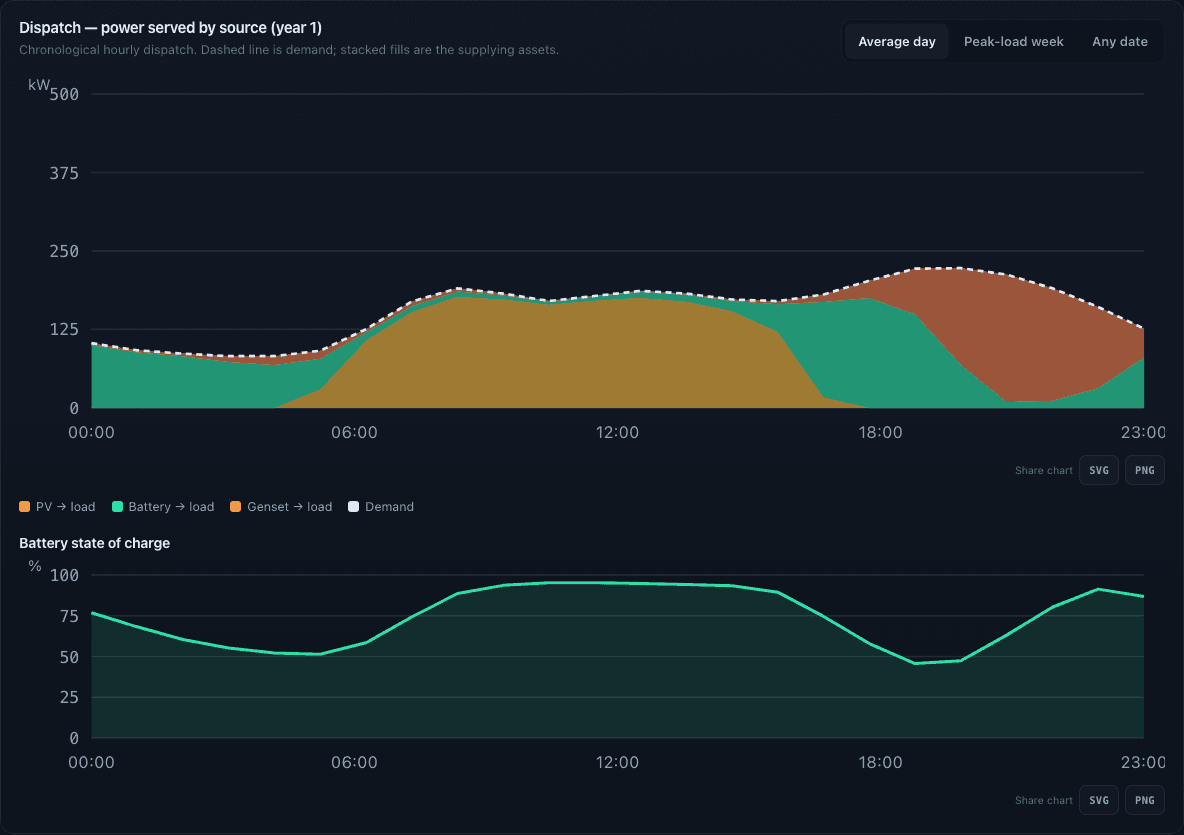
Annual energy totals can hide the hours when a system runs short, curtails renewable production, or depends on fuel. MicrogridModeler keeps the chronology intact and lets teams move from inputs to an exportable review package in five steps.
- 01
Begin with an hourly demand case
Choose a reference project or bring an 8,760-hour load file. Resource, load, tariff, and cost inputs carry source labels so a reviewer can distinguish measured data, public datasets, user inputs, and defaults.
- 02
Build the candidate system
Configure PV, wind, battery storage, diesel-generator fleets, and an optional grid connection. The workspace exposes operating limits and component assumptions instead of burying them behind a single capacity result.
- 03
Run chronological dispatch
The engine simulates the energy balance hour by hour and supports four dispatch controls. Battery state of charge, generator behavior, renewable curtailment, unmet load, and operating reserve remain visible throughout the run.
- 04
Compare feasible designs
Candidate systems are checked against supported reliability and operating constraints before net-present-cost ranking. Teams can inspect lifecycle cost, LCOE, renewable fraction, fuel, baseline savings, payback, and IRR together.
- 05
Export the evidence
A run package combines inputs, provenance, results, engine version, hourly outputs, and a content fingerprint. That gives collaborators a concrete artifact to review—and a way to reproduce the same result from the same inputs.

Reviewability
Designed for the questions that follow the first result.
The platform publishes its methodology and keeps its optimization claim deliberately bounded: it reports the lowest-net-present-cost feasible design among the candidates evaluated. That distinction matters. It tells a reviewer what the search can demonstrate without presenting a sampled sizing exercise as an unlimited mathematical proof.
Inputs
Where did the load, weather, tariff, and cost assumptions come from?
Source labels and provenance travel with the run.
Feasibility
Did the recommended design actually satisfy the selected constraints?
Supported limits are evaluated before cost ranking, with violations exposed.
Search
What design space did the sizing process evaluate?
Candidate bounds, coarse search, refinement, and boundary warnings are inspectable.
Reproduction
Can another analyst reconstruct the model and hourly result?
Inputs, outputs, provenance, and hourly CSV data export together.
Project development
Where the modeler fits—and where detailed engineering begins.
MicrogridModeler is a single-bus energy-balance and techno-economic planning tool. It can help a team screen architectures, test reliability and cost assumptions, compare scenarios, and assemble a traceable pre-feasibility record. It does not claim to replace feeder power flow, protection coordination, cable studies, interconnection engineering, controls design, or stamped construction documents.
Explore the global project directory, compare the major microgrid types, and understand the operating context.
Use the site, load, reliability target, resource options, and local economics to define a credible planning case.
Run dispatch, sizing, sensitivity, resilience, and baseline comparisons in MicrogridModeler.
Carry a reviewed concept and explicit assumptions into power-system studies, equipment selection, procurement, and detailed design.
From the archive
Start with evidence, then build the case.
A community resilience hub, an island utility, a remote industrial site, and a campus microgrid may use similar technologies for very different jobs. Before opening the modeler, browse the market lenses and the project archive. The strongest first model is grounded in the operating problem—not copied from a generic equipment list.